Monday, August 24, 2026

POTA at a New Park

Everyone had something to do this morning except me (well..mowing, but that doesn't count), so I grabbed my kit and headed out.

Rake's Creek WMA is not too far from home. I discovered it was not on the POTA list, so several days ago I contacted the NE park map manager and asked him to add it. Sweet. Today I went there while everyone else in the house was doing their thing.

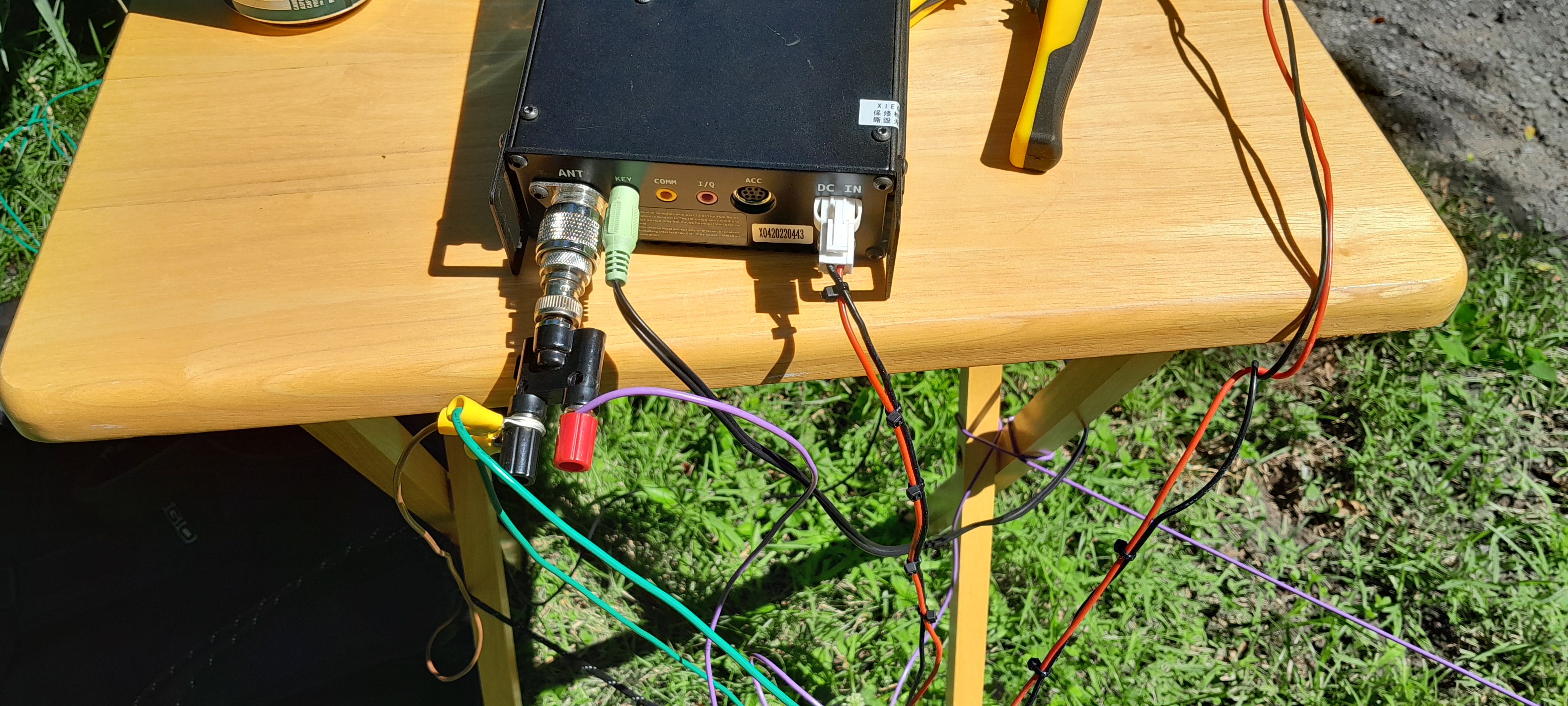
Here's the kit: Antenna bag with arborist bag and line, wire spools, etc. Home made power box with LiFePo4 batteries (about 16AH for small trips), USB and power poles. One set of power poles is straight battery voltage, the other set is variable 5-36V. Third box is 3 radios: Pebble HF 20M all mode QRP, QMX+ multi-band, multi-mode QRP, a QRP antenna tuner, and the trusty Xiegu G-90, 20W HF-6 meter all mode. The luggage is all Harbor Freight. Free toolbag, large and small ammo cans.

The park is a quiet little Wildlife Management Area that I had only recently discovered while looking at a map of Nebraska public lands. It's not the closest, but it is very peaceful. The closest POTA spot to me is right on the train tracks.


First I tried the Pebble HF with the Just OK antenna. (Didn't take pics doh!) It was not going too hot, so I got out the 66 foot whar. (A whar is a long thread of metal, usually copper, available in varying thicknesses...you know what I'm talkin' about.) I walked it out down the access road and when I got to the end of the spool, I chucked my arborist bag up over a branch and pulled up that end of the antenna.
Back at the truck I attached it to a 4:1 balun and hooked up the counterpoise from the "Just OK." Connecting the coax to the balun, "it was at this point that I realized, I screwed up." Lol I had an adapter to connect the G90 to the Just-OK, BNC f to pl259, but i did not bring an adapter to connect the Pebble to this coax, so239 to BNC m.
Doh!
So the Pebble and the QMX+ both had to go back into the box. I was kinda bummed because I really wanted to use them, but was glad I brought 3 radios! Just goes to prove the old adage: Two is one and one is none.


So I fired up the G90. 20 meters was roaring, the Ohio QSO Party was rocking the band. I was able to find a pigeon hole and spotted myself and started calling CQ. Logging Q's and having fun, I thought to myself "oh hey, Utah! That's great!" The "North Carolina! Wow!" Then Vermont! After the signal report exchange, I asked the ham from VT "please cfm on QRZ. VT is my last for WAS." He said "Will do!" What a great activation.

And then...ALASKA! Holy cow, I'm sitting in a park, in my truck, running 20 watts, and I'm reaching Alaska! He gave me a 4-1-9, but the important numbers are the 4 and the 9. Strength, the middle number, doesn't matter if readability, the first, is 4 or 5.

After a few more, 36 total contacts, I was ready to eat something and wrap it up, so I packed everything up and departed for home.

Once back, I headed to my computer to upload the logs. I was excited to be the first to activate this new park. Imagine my surprise when I discovered that two hams had already beat me to it! ARGH! I just asked for this place to be put on the map! How did they know?? Oh well, I hope they had as good a time as I did.
I don't do it as much as I'd like, but POTA is a lot of fun! There's just something about operating portable, outside.
Thanks to all the hunters that worked me today. It wouldn't be any fun without you.
Yes, when I got home, I did the mowing. 🙄
Lol
73!

Wednesday, September 24, 2025

The ARRL Radiogram

On this week's ARES net we gauged experience with traffic handling and decided that starting next week we will begin training on the subject. We will start with the ARRL National Traffic System (NTS) Radiogram.

Pictured here are two examples of radiograms. 
The first is a Standard radiogram. It reads like a typical message:


The second example is an Numbered radiogram. It uses a code for brevity and does not read as easily as the standard radiogram:

We will discuss this form on the next net or two as needed, and then we will practice sending and receiving radiograms, or "handling traffic."

At the following links you can download a radiogram form that I created as a spreadsheet. A similar product used to be available, called the "pink sheet."  This one isn't pink but it has all the same info and more. They are all the same form, just in different formats. The PDF probably will look the best, as it is essentially a snapshot of the file as I created it. Not sure how well the other formats converted as I exported them.

PDF

MS Excel

 Open Document Standard

Tuesday, July 1, 2025

Field Day 2025

Once again the Plattsmouth Amateur Radio Club held annual Field-Day operations at Young Park in Murray Nebraska. Thanks to the people of Murray, the Council and Mayor for hosting us.


Setup began around 9AM Saturday morning. This year a new club member, Justin, brought his trailer, but this is no ordinary trailer. It was a decommissioned military SkyWatch ® tower trailer! The Skywatch has a 7KW generator and a hydraulic lift system. In the picture above, on the right side of the trailer you can see the guard shack. Inside is a seat, and a 360 degree view, plus all the controls for the raising and lowering of the shack, the two search/spot lights, and the heating and A/C! Yes...it has air conditioning!
We didn't use it as an operating position....this year...  We hung a G5RV from the guard shack.

On the left side of the trailer, Justin mounted a pneumatic telescopic mast from a TV news van. You can find amazing stuff at the local scrapyard! On the mast we mounted a 20-foot vertical. The mast raises to 35 feet, so at the tip we were 55 feet above ground. The shack raises to 25 feet. The trailer has four outriggers and the tongue jack for stability and originally spec'd at 60MPH wind survivability/stability WITH A MAN INSIDE! I dunno about you, but...I might be a little nervous up there in that kind of breeze!
Of course we had food! We went simple this year and did cold-cut sandwiches, chips, etc. Best part about the food is the company anyway.
  
Above you can see the tower and mast in their fully extended glory.

We set up two operating positions under a pop-up canopy. The goal was to have a voice and a CW station. Using N3FJP's fine software between a few connected laptops, it would tell us if we were close to the other Op's band and could stay away from each other, minimizing interference. After the event began, there was some difficulty at the voice station and eventually it was shut down leaving us with just one radio, so we shared and alternated between CW and Voice modes.

We operated from our single position all night long, working 43 states including Hawaii, and several DX stations as well. I heard later of a club that did 2000! Don't know how many stations they had, but wow.

We had been concerned about weather and continually got updated reports from our cell phones on probabilities for rain, as well as timing. Earlier in the activity we expected possible thunderstorms around four, but as time passed, the time for storms moved back more and more, until the forecast said noon would be the time for rain, and the winds wouldn't be above 11mph. Sounds great.

As the sky began to lighten in the east and the birds began to sing, about 5AM, we decided to tidy up a bit and talk about how long we were going to operate. The second station had been put away in a vehicle, so we began to put away everything else related to that. We lowered the guard tower to put away the G5RV, and that was when I saw it. A black shelf cloud appeared ominously in the northwest. I commented to John "That looks threatening!" After rolling up the G5RV I looked again, and that black shelf cloud was nearly upon us! We hurried to get the remaining radio and all the laptops put away out of the weather as the wind picked up and the first drops fell on us. Before we knew it, it was a driving downpour, soaking us to the bone and giving quite a chill as well. Happily, the only damage was to my pop-up tent. It was taco'd around a tree trunk.

With everything secured, we sat in our cars waiting for the storm to pass, trying to warm up and maybe dry out just a little. I was very glad that I brought extra clothes to change into. Once it was clear to come out, we hooked up the trailer and decided that we would not get everything out again, but we'd just call it good and head for home, a warm shower, and a nap! 

Despite the weather, we still had fun. We learned some lessons for next year, and proved we could reach others in all directions, which is kinda the main point. 

I'll leave you with this picture of the moon rising through the middle of Derek's magnetic loop. Pretty, isn't it?

Saturday, June 29, 2024

First POTA

 I finally got all the pieces together and went out to do a Parks on the Air activation. The two closest parks are currently beneath the currents of the Missouri River, so I had to go to plan C. Boy am I glad I did! 

I had never been to the Glenwood Archeological Preserve until this morning, and it is a really pretty spot. Also, lots if great trees for tossing up a line and getting an antenna in the air.

Not counting setup and take-down, I operated for roughly an hour and 45 minutes and made 41 contacts. It was a lot of fun!

Here are some pictures:


I used my Xiegu G90 at 10 watts, TalentCell 12V 6Ah battery, CWMorse paddle, and a 66 foot end-fed sloper. Worked pretty good. Definitely going to do this again!

Sunday, June 23, 2024

Field Day 2024

On the fourth full weekend in June each year there is a nationwide emergency communications exercise called "Field Day." Amateur radio operators and clubs practice deploying ad hoc communication networks "in the field" under emergency conditions like battery, solar, or generator power and use improvised antenna systems. The event lasts a full 24 hours and stations log their contacts to be submitted for points. 

 The Plattsmouth Amateur Radio Club set up in Murray at Young Park. Here are some pictures.


Friday, August 12, 2022

This Week at Amateur Radio Station N8VCL 6-12AUG22


5 QSO's

Not a huge week. But that doesn't mean I haven't been on the air. This week, for something new, I checked in or at least listened every day to the Nebraska Morning Phone Net in the mornings, and in the evenings, the Nebraska CW net, Kansas Net, or the Tenth Region net.

A "Net" is a network of ham radio ops who work together to "pass traffic" as part of the NTS or National Traffic System. "Traffic" could be any non-commercial communication from one person to another, anywhere in the country. It's like sending a telegram, but there's no charge and the message can't be for business purposes. Congratulations, Happy Birthday, Planning to arrive on the 3th etc etc.could all be "traffic" passed by the NTS.

A person can contact a Ham and say "hey, can you send my gran in San Diego a message?" The Ham takes the message, and puts it into the format used by NTS. That evening, he checks in to the local repeater net where folks from the surrounding area, say 25 mile radius, congregate on the air at a specified time. For example, a club here has a net every Monday on the club repeater. Folks from all around the Omaha area check in and there are announcements about club activities, maybe a trivia question, birthdays, anniversaries and other announcements, a time for everyone to make comments, etc. At this net, our Ham can check in and let the "Net Control Station" know that he has message traffic. The "Net Control Station," is the guy "in charge." He asks everyone "Can someone take this message for  California?" Some nets have designated liaison stations that always represent them at the next level. In our local example, another ham on the net hears and responds that he is going to check in to the state-wide traffic net later, so he can take the message. Net Control tells him to meet the other ham on a different frequency where they can pass the message.

Our man then checks in to the state-wide net and the scene is repeated, this time to the regional net, and once more to the area net. The Area Net folks then make trans-continental connections. Our message would go from an Omaha net to Nebraska, to "Tenth Region" which is NE, IA, KS, MN, MO, SD, ND, Saskatchewan and Manitoba, then to the Central Area, which covers the middle of the continent. From Central Area, a Trans-Continental Corps operator contacts his regular liaison in the Western Area, and the message follows a similar path from Area to Region 7, to California section, to a local San Diego net and a helpful Ham in San Diego will deliver the message to the destination by phone or in person.

Crazy! That's gotta take a long time!  Nah. Most messages are delivered within 24 hours.

To ensure efficiency, the nets run in cycles throughout the day, and from east to west, they follow each other on the hour across the country. For example, in the 4th daily cycle, there are region nets in the Eastern area at 9:30PM ET, then here in Central at 9:30 CT, etc. so a message from NE to CA could be delivered to the final destination in just a few hours.

So I have been checking in to the Region 10 late net daily. I've sent messages to Hawaii, Florida, and Ohio, and I've received and delivered a few in the Omaha area.

While I have checked in to nets before, this is the first time I've passed traffic. It has been fun, kind of exciting.

I know what you're thinking. One or both of the following:

  1. What in the world? I can pick up my cell phone and text a person on the other side of the planet nearly instantaneously. Why would I ever use such a slow and antiquated method??
  2. I'm remembering the proverbial game of "Telephone" where the message is terribly mauled by the time it gets to the destination. This sounds like the same thing.

To #1 I respond "You wouldn't. Unless..."  Yes, it's slower than texting or emailing, or even phone calls. The NTS was designed at a time when not every house had a phone, long distance calls and telegrams were expensive, and there was no other way besides mail that could take a week or more. We've advanced beyond that, but could those conditions ever return? Have you heard of the Texas ice storm blackout? Great Northeast Blackout? Hurricanes, floods, tornadoes, natural and man-made disasters could all pose a threat to the infrastructure we rely on today. When those situations arise, it's nice to have a group of people trained and equipped to get messages into and out of stricken areas where services are down. The guys who use home-made radios with battery packs charged by the sun will be worth a million smart phones.

To #2, NTS messages are typed/written in a specific format pictured above. There are built in error checking aspects to the messages. Also, when the messages are transmitted by morse code, there's no hearing an "S" and thinking it was an "F" etc. It's robust and reliable.

So that's how I spent most of my radio time this week. I don't log net participation because I don't think it counts that way. There is a log of my participation, and on my computer I have a log of the messages that have come through my station.

It's a lot of fun. There's camaraderie and skill-building in the process, and there is a certain romance to the whole thing. It is technologically anachronistic, but...so am I.

Thanks for reading! If we had a QSO this week, thank you!
If we didn't, I hope we do soon.
73!


 "This week [...]" is a summary of Radio-related activity from Saturday through Friday.


Friday, August 5, 2022

This Week at Amateur Radio Station N8VCL 30Jul - 5Aug22


 12 QSO's, 9 CW, 3 FT8.
Longest: EA1DR in Spain, 4454 Miles.


This picture sums up the last couple weeks.

I got an alert on my phone just as I turned on the radio. "Transequitorial coronal hole." What's that? It's like a giant belch, spewing forth a blast of solar winds that, as they crash into the magnetosphere, bend the earth's magnetic field, causing mild to moderate geomagnetic storms which tend to rain on the radio wave propagation parade. Great for auroras tho...

It takes some time for solar winds to smash into the earth. More than the 8 minutes it takes light to get here. Solar wind generally travels at around 200 miles per second, so about three days to make the trip from the sun. 

But the sunspots have been way down, and other conditions make it seem as if I have no antenna connected.

And ...it's just creepy that it looks like there's a face looking out! He's saying "I'ma eat yo radio waves!"

Some other things: I disassembled the Loop. Yeah. Bummer.  I was surprised to see that it performed more poorly than my end-fed wire, both according to my S-Meter on receive and on other folk's meter when I was transmitting. All is not lost. It's still tossed up over that super-high branch. I'm thinking of trying to make it just a really long random end-fed, or some kind of folded dipole. We'll see.

I also got a voltage regulator to power my Cricket 40 from the 13.7 volt power supply. It lets me turn it down to 9V flat, so I can sit there and pound out CQ CQ CQ for 2 hours and not have to buy 100 9-volt batteries to keep the power on.


Well hopefully the sun will start cooperating more...otherwise I'm going to look at home-brewing an amplifier! ha!

Thanks for reading! If we had a QSO this week, thank you!
If we didn't, I hope we do soon.
73!


 "This week [...]" is a summary of Radio-related activity from Saturday through Friday.


Log